

Sojourner's Song

“I have become a pilgrim to cure myself of being an exile.” -G. K. Chesterton


Aaron Telian

I'm a clumsy Christian on a journey of discipline and discovery with Jesus. As a recovering Pharisee, I'm learning to trust God's grace over my goodness. I love the world, and I'm excited about learning what it means to be salt and light in a Post-Christian culture. This is where I write about living the sojourn.


View My Profile

Blog Archive

  • ▼  2009 (26)
    • ▼  June (1)
      • Standing Up For Nothing
    • ►  May (2)
    • ►  April (10)
    • ►  March (1)
    • ►  February (3)
    • ►  January (9)
  • ►  2008 (112)
    • ►  December (5)
    • ►  November (10)
    • ►  October (1)
    • ►  September (5)
    • ►  August (8)
    • ►  July (6)
    • ►  June (13)
    • ►  May (13)
    • ►  April (4)
    • ►  March (9)
    • ►  February (18)
    • ►  January (20)
  • ►  2007 (121)
    • ►  December (8)
    • ►  November (12)
    • ►  October (10)
    • ►  September (8)
    • ►  August (8)
    • ►  July (12)
    • ►  June (11)
    • ►  May (11)
    • ►  April (10)
    • ►  March (14)
    • ►  February (5)
    • ►  January (12)
  • ►  2006 (90)
    • ►  December (16)
    • ►  November (15)
    • ►  October (17)
    • ►  September (20)
    • ►  August (11)
    • ►  July (11)

What Susan Said

  • What Susan Said
    - Due to time limitations and lack of quote material, What Susan Said will be indefinitely discontinued. If you’ve enjoyed this blog, leave a comment and l...
    17 years ago

Blogroll

  • As The Deer
  • Bibliological Bibble-Babble
  • Cerulean Sanctum
  • Coffee Cup Apologetics
  • Free Believers Network
  • Greg Boyd
  • Internet Monk
  • Jesus Shaped Spirituality
  • Kingdom People
  • Letters From Kamp Krusty
  • MercatorNet
  • My One Thing
  • Reclaiming the Mission
  • Solomon's Porch Oakhurst
  • The God Journey
  • The Gospel-Driven Church
  • The Scribbles of a Sojourner
  • What Susan Said


Sponsor a Child in Jesus Name with Compassion
Save Children

Labels

  • Art
  • Blogging
  • Books
  • C. S. Lewis
  • Church + State
  • Church Life
  • Culture
  • Derek Webb
  • Economics
  • EduCore
  • Emerging Church
  • Family
  • Freestyle Piano
  • G. K. Chesterton
  • Happenings
  • Hiking
  • History
  • Holiness
  • Israel
  • Jesus
  • Language
  • Music
  • Nature
  • People
  • Photos
  • Poetry
  • Poverty
  • Prayer
  • Reading + Writing
  • Religion
  • Rich Mullins
  • Scraps
  • Scripture
  • Society + Government
  • Southwest Slalom
  • Spiritual Thoughts
  • Story
  • Technology
  • Travel
  • Yosemite

My Amazon.com Wish List
cash advance
Dell Computers
Free Counter
RSS Feed
Add to Technorati Favorites

Thursday, November 30, 2006

Blogging or Globbing?

I developed early on a sort of unspoken rule that I would not spend too much time blogging about blogging, as it seemed to me a rather circular endeavor. Besides, I'm largely unqualified to sermonize on the subject, being somewhat of a muddled milksop when it comes to cybernetics. But never mind; just think of this post as "Mr. Bean goes to Blogville."

I am thoroughly fascinated with blogging as a both personal and information-rich medium. There is a staggering quantity of ideas, news, and research that is available to anyone, anytime. I am starting to feel that this budding technology, for all it's flukes and flaws, will be playing a significant role in the immediate future of Christianity.

About a week ago I was invited to join Christian Bloggers. Whether they found me by pure accident or were tipped off, it earned me another button on the sidebar and possibly a few more daily hits, (not that either has any meaning). This network stops far short of embodying what I see as the medium's Kingdom potential, but it appears to be hardboiled and harmless. (If you happen to be interested, it is simple to join on your own initiative.)

In the reading department, I recently plowed through BLOG to try to bring myself up to speed a little and stop blogging by torchlight. Written by Hugh Hewitt, a Christian radio talk show host and blogger, the book describes how the blogosphere is dismantling the Mainstream Media monopoly on information, and describes some statistics and stories that are quite interesting.

According to BLOG, a full two-thirds of blogs that are started are ultimately deserted by their bloggers: the average abandoned blog lasts about four months before trailing off into the cold oblivion of outer-cyberspace. I guess that means I am either safely out of danger or inescapably hooked.

The book has a decided political emphasis, and commercialized blogging is preached as a matter of course. For myself, I can't help but hope that there remains a remnant who see advertising as the distasteful distraction it is. Blogging may be a marvelous tool, but much of it remains grossly and unquestionably materialistic.

The Economist has some interesting things to say about Web 2.0, the budding internet standard devoted to new media such as blogs and podcasts. (Speaking of the Economist, you may want to check out this recent article from Mercator.net about the magazine. I don't agree with all of Mercator's conclusions, but it's an informative third-party overview nonetheless.)

As I have intimated in previous posts, the whole affair is a good bit trickier than it looks. There is a fine line between blogging and globbing. Mud is easy to find. Diamonds are not.


Image courtesy of hovedetpaabloggen.dk
Posted by Aaron at 9:55 PM No comments:
Labels: Blogging, Books, Technology

Tuesday, November 28, 2006

Heaven and Hell

A month ago I promised to examine the subject of Heaven and Hell a little closer. Since then, courtesy of Garrett, I had the chance to read C. S. Lewis's The Screwtape Letters, in which a senior devil coaches a young apprentice through the finer points of sophism and chicane. (The book reads rather uncomfortably, for two reasons: firstly, it is properly uncomfortable to be thinking in the devil's shoes, and secondly, it gradually occurs to you that he is watching you too.) I guess you could say I've had the benefit recently of viewing the topic from several angles.

Note: In the interest of brevity we will take for granted here that Heaven and Hell are valid realities.

We're all familiar with "fire insurance" Christianity, (that shallow nonsense preached by all those "cheap Christians",) but I doubt we're aware of how deeply this cancer has penetrated our own thinking. Present-day society has infected Christianity with a preoccupation around m-e. We have found the sickness difficult to be rid of, so we conveniently spiritualized it, and wound up with a cute little creed that "gets you into Heaven."

Don't let anyone tell you the Bible is simple. It is not. Even Peter described the writings of Paul as "hard to understand," and we do well to approach the word of God with reverence and respect. And it's not bad to be plain puzzled once in awhile.

For some time I was roundly stumped by a few particularly thorny verses. Listen to Moses, in Exodus 32:32, pleading with God for the children of Israel: "Yet now, if thou wilt forgive their sin--; and if not, blot me, I pray thee, out of thy book which thou hast written." Paul echoed a similar sentiment in Romans 9:3: "For I could wish that myself were accursed from Christ for my brethren, my kinsmen according to the flesh."

Now those to me seemed to be some the most reckless, ridiculous statements in the whole of scripture. That they were made by devout, sincere men only further baffles the enigma. What gives?

Somewhere along the line, we have purchased this idea that Christianity exists mainly for my own personal comfort, I mean, (ahem!) my own eternal destiny. This rhetoric sounds very slick and spiritual until we notice God standing there shaking his finger and saying to us, like a parent to a selfish child, "Now who are you thinking about?"

As Lewis points out, we are working the problem the wrong way around. (If you didn't read this excerpt from Reflections on the Psalms, you should do so.) Too many of us are devoted to ourselves, and too many of the rest of us are devoted to God for ourselves. It is severely difficult to just be devoted to God.


Image courtesy of bamjam.net
Posted by Aaron at 7:43 PM No comments:
Labels: Books, Spiritual Thoughts

Monday, November 27, 2006

World War II: Deeper Perspectives

Os Guinness inspired me to cram some history into my reading schedule, so I turned to two book-sale acquisitions covering the second world war.

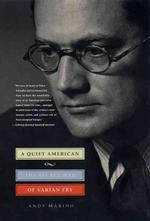
A Quiet American chronicles the life of Varian Fry, an American who traveled to unoccupied France and set up an underground immigration network for refugees who were in political danger as intellectuals, artists, or writers. Over the course of a year, he helped many now-famed personages evade the clutches of the Gestapo and reach Ellis Island. (Incidentally, I just found Lion Feuchtwanger's Proud Destiny in a local book nook.)

Replete with forged passports, money from the black market, and boldfaced lies, Fry's operation raises all sorts of knotty ethical questions. The author is predictably sympathetic to Fry and his tactics, and draws you into the urgency of the moment, as the ebb and flow of French patriotism surges around you and the world wakes up to the harsh reality of world war.

These questions run much deeper than multiple-choice mathematics. Even the mild Dietrich Bonhoeffer snapped when confronted with the stark horror of Nazi brutality, joining the July 20 plotters in their unsuccessful attempt to assassinate Hitler. In Fry's case, he based his network on entirely secular morals, and it seems his work is properly applauded as a triumph for the cause of secular freedom.

Last Words, "A Memoir of World War II and the Yugoslav Tragedy," recounts the experiences of Yugoslav POW Boris Todorovich, who escaped a German concentration camp to eventually rejoin the Yugoslav resistance forces. Composed of numerous ethnicities, Yugoslavia was ruptured in several directions by the war. The Croats defected to the Germans, turning in Serbs as prisoners or worse, and the Serbs were divided into two parties: the Communists, led by Josip Tito, and the Chetniks, led by Draža Mihailović.

Todorovich, a passionate nationalist and freedom fighter, identified strongly with the latter group. Unfortunately, since the Communists struck more effective blows against the Germans early on, they became the de facto recipients of Allied aid, which they used to vanquish their rival party.
Mihailović was eventually executed by Tito's Communist regime.

Being an autobiographical account, certain pieces are undoubtedly skewed to fit Todorovich's ego and ethics, and the narrative lacks the usefully critical commentary of an outsider. There is, however, value in the firsthand, and the book offers a singularly cutting perspective in that the story does not end well.
Posted by Aaron at 8:35 PM No comments:
Labels: Books, History

Friday, November 24, 2006

Thinking About Originality

If you've known me (or read my blog) for any length of time you know I have a bad case of broken-record syndrome. I like books. I like dismantling society. I like Rich Mullins.

It doesn't help that my vocabulary tends to run in circles. I like vague, squishy words such as beauty, or truth, or real. I teeter between the poetically profound and the peculiarly preposterous. (And I suppose I should admit an alliteration addiction, as well.)

My number one writing aid? Thesaurus.com, by an embarrassingly wide margin. Secret of the just-add-water pundit? None other than the venerable and indispensable Wikipedia.

Really, to be shallow is no crime. Oswald Chambers put it well on the 22nd: even the ocean has a shore. (Sometimes, of course, we may need to verify whether the shore has an ocean.)

Sometimes I think the reader's patience must be the eighth wonder of the world. There is certainly plenty of typographical turbulence around here. It must be supremely frustrating to be bored as bananas one day and startled out of your skin the next. To simply be interesting is not as easy as it sounds. And as for originality, forget it. There's nothing new under the sun, and no one knows it better than the pioneer. (Not to mention the large degree of mutual exclusivity between education and originality.)

But we don't appreciate people primarily for being original; we appreciate them for being themselves. We love the baker, not because he is always busy mixing up some new recipe, but simply because he makes really good bread.
Posted by Aaron at 5:14 PM No comments:
Labels: Blogging, Reading + Writing

Thursday, November 23, 2006

The "I" in iPod

Progress is not truly progress solely because it is labeled so. What looks to be a new standard of freedom may often be nothing more than a new standard of sterility.

The ipod may be one example. It is now possible to carry 1,000 songs around in your pocket like a pack of gum, redefining "music to-go." And so we have this sort of mini-revolution in the realm of personal audio. Everywhere you go you see folks with the telltale white cords hanging out of their ears, enjoying - or enduring - their own private concert.

I'm trying to get used to it, and I'm not sure it's working. I feel like I'm crowded into my own little world - the music is all cramped up, and so am I. With an ipod, you no longer feel inclined to roll the windows down for that really good song, and it's putting me a little out of sorts.

Music is meant to be shared. It's meant to float out into the open air (within the constraints of consideration, of course,) where it can reign free in the auditory atmosphere. You can't sing along with an ipod without sounding stupid; even tapping your foot is bound to earn you a quizzical stare. No: now music, along with everything else, must be all business.

But this is a travesty, and here's why: music is meant to be absorbing. It's meant to lift you up, to be something that is simultaneously, gloriously, wholly connected to life and yet wholly other. (It may be significant to some that, in heaven, we "sing" the "song" of the Lamb. Why couldn't we just recite a eulogy?) But in the new world-to-myself mania, music is in danger of becoming just another boring backdrop, drumming along in the borders of your consciousness like a squeaky shopping cart. Rock 'n' dull.

So, as much as I treasure the space between my ears, ultimately I desire that my world would outgrow the confines of that narrow spread. God calls the very mountains to sing - to send the crashing crescendos of redemption echoing through the cosmos. That tells me we ought to take the lid off: as Steven Curtis Chapman put it, "Live out loud."
Posted by Aaron at 9:42 PM 2 comments:
Labels: Music, Society + Government

The Last Honest Holiday

Thanksgiving is the one secular holiday I can celebrate without scruples; free of the commercialization of Christmas, the obscenity of Halloween, the absurdity of Easter, or the uncomfortable patriotism of The Fourth of July.

Besides, I really like cranberries.
Posted by Aaron at 12:43 AM No comments:
Labels: Happenings

Friday, November 17, 2006

The Definitive Orthodoxy

I have completed my upside-down exploration of the authoritative Chesterton trilogy, consisting of The Everlasting Man, St. Francis of Assisi, and now, Orthodoxy.

It is rather intimidating to approach a book that has attained nearly mythical status. These days it seems that if you want your work to be taken seriously, you must include the obligatory quote from Chesterton, and this is hard to do without casting a pallid gray shadow over your own writing.

Because of this, it's the kind of déjà vu classic that continually stirs your consciousness with remotely familiar passages, like driving through the shaded streets of a town you have never been in but many people have told you about.

I was not disappointed. The work is deserving of its decorations: in the awed words of the Queen of Sheba, "The half was not told me." I just love the way authors like Lewis or Chesterton sneak Christianity up on you, skillfully presenting it as the surprising, satisfying thing that it properly is.

This is Chesterton's Mere Christianity; likely his most fundamental work, certainly his most formidable: a crashing coup d'etat of the sour skeptics. In a healthy but reasonable 170 pages, He embarks on a wild romp through doctrine and discovery, taking the Apostles' Creed as a sort of loose outline. His enthusiasm for life is unmistakable, converting one's anxious prejudices almost immediately.

A work of this impregnable proportion is difficult to criticize, and it is with fear and trembling that I suggest an oversight. It seems that Chesterton, in his zeal for provocative paradoxes, has overlooked the essentially nonviolent nature of Christianity. He appears to have accepted and even defended the legacy of the Church Militant, which I find extraordinarily difficult to do with a clear conscience. It is not enough for this history to be dusted off and propped up; it must be repudiated. For myself, I see nothing unorthodox about representing the Inquisition or the Crusades as colossal mistakes.

Foibles aside, this masterpiece has earned its place in the list of required reading for the conscientious Christian. But perhaps "required" is the wrong word; "rewarding" may be more appropriate.

"Whenever we feel there is something odd in Christian theology, we shall generally find that there is something odd in the truth." - Chapter VI, The Paradoxes of Christianity


Image courtesy of stfrancisonline.com
Posted by Aaron at 11:20 AM No comments:
Labels: Books, G. K. Chesterton
Newer Posts Older Posts Home
Subscribe to: Posts (Atom)

The Fine Print...

All material on this blog remains my intellectual property. You are free to quote and disseminate any and all of it, but please use proper blogging etiquette, credit (link back to) the source, and make an effort to keep potentially controversial ideas in context. Thanks for reading.

Finally, brothers, rejoice. Aim for restoration, comfort one another, agree with one another, live in peace; and the God of love and peace will be with you. - 2 Cor. 13:11